QCEA - Quaker Council for European Affairs - the Quaker office based in Brussels, have just posted two blogs related to trends in Europe to do with the development of "defence" thinking in Europe.
While Brexit is not a focus of QCEA, our work on peace and human
rights makes one thing abundantly clear to us: from foreign aid and
migration policy to the global sanctions regime, the EU really is “the
only game in town.” Funnily enough, the British government seems to
agree.
The ‘
Chequers Plan’
– the white paper which is still officially the UK’s negotiating
position on Brexit – reads like a long list of reasons to remain.
Indeed, as early as page three, the recently-appointed Brexit Secretary
writes about building “unprecedented, unrivaled, unparalleled”
partnerships in economics, security and data sharing. To achieve this,
he says, “we will need a new model of working together that allows the
relationship to function smoothly on a day-to-day basis.” Doesn’t that
sound a lot like EU membership?
This is the contradiction which has caused so many problems for the
white paper: it seems like a muddy, legally unworkable compromise which
satisfies nobody. To Brexiteer Conservatives, the white paper’s contents
represent a kind of “vassalage”, so intolerable that several have quit
the government altogether in protest; for the EU, the document is just
more of the same flagrant cherry-picking.
In a sense, both might be true. But amid the hubbub of discussion
about customs agreements and the Irish border, important implications of
the white paper are being overlooked.
*
The Brexit referendum was the conclusion to a decades-long campaign
of national hysteria about EU meddling, whipped up by a coalition of
journalists and politicians. Among their many breathless warnings was
the “secret German plot” to establish an EU army – a development which
was apparently just around the corner for twenty years yet never seemed
to transpire.
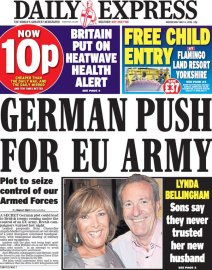
Although the concept of an “EU army” is something of a simplification, the Union
has pursued
rapid militarisation in the last 18 months.
Wracked by internal disagreements about migraton, and faced with
authoritarian nationalism at home and abroad, it’s perhaps little wonder
that European governments are seeking to “go it alone” (with the global
arms industry offering a nudge of encouragement, of course). The UK –
faithful friend of NATO and allergic to any suggestion of European
statehood – was the perennial thorn in the side of these ambitions.
Ironically, the British vote to leave the EU has been the impetus for
militarisation to begin in earnest. Even more ironically, the British
want in. As early as May 2018, HM Government was quietly publishing
working documents
which made clear just how enthusiastic the UK has suddenly become about
EU military activity, even pledging to make “future contributions to EU
Battlegroups”. (To be clear, “contributions” refers to human lives.)
It seems the only thing less tolerable to the British than the existence of an EU army is being excluded from it.
The Chequers Plan, which was agreed by the Cabinet before being
rubbished by many others, doubled down on the double standards. Among
the British government’s shopping list for negotiations are:
- continued UK membership of the EU’s Political and Security Committee
(PSC), which makes decisions on EU foreign policy, as well as the
attendance of the British Prime Minister at some meetings of the EU27;
- continued involvement with the EU Military Staff (EUMS), as well “no
drop-off” in existing cooperation on development funding and crisis
management, and
- guarantees for arms trade supply chains to be uninhibited in the event of a “no deal” Brexit.
The white paper also says:
“
The ability to protect citizens within Europe is increasingly
intertwined with broader foreign policy, defence and development
objectives outside Europe. It is necessary to have a single, coherent
security partnership between the UK and the EU to address: the roots of
terrorism and prevent attacks; identification of terrorists and efforts
to bring them to justice; instability in the neighbourhood and work to
prevent offering a haven for organised crime; migration challenges
affecting Europe; the provision of development funding across the world;
and the use of data in a range of contexts.” (Chapter 2.1.3)
Again, before becoming an advocate for “an unprecedented depth and
breadth of cooperation to keep people safe”, the UK was vehemently
opposed to any such collaboration at all, going so far as to
negotiate opt-outs from justice and home affairs policies enshrined in the Amsterdam Treaty. In a Vote Leave
pamphlet,
pro-Brexit MP Michael Gove complained (wrongly) that these same EU
policies mean Britain is unable to deport all of the people it may want
to. So why did he
vote to re-apply them in 2012, 2013
and 2014? And why did he back the Chequers white paper which endorses them so wholeheartedly?
*
The Chequers Plan is full of this hypocrisy. There can only be two
conclusions: either leading Brexiteers willingly played the public
consciousness or are now in damage-limitation mode, panicked by the
scale of Britain’s impending isolation.
It’s undoubtedly true that Britain’s political class, like many of
us, failed to understand the vastly significant role the EU plays in
international security, humanitarian aid and foreign affairs more
generally. Unless the UK’s vision of itself as a global player is to
change drastically, it can ill afford to cut itself off from the
European juggernaut. But for many of us – particularly Quakers – the
Chequers Plan also raises difficult questions about what the European
Union will look like in the years to come. It also reminds us of why
Quaker voices in Brussels are important.
That Britain’s political hawks are suddenly so excited about European
cooperation is a meagre endorsement of the EU in 2018. Whither peaceful
cooperation?
The weight of expectation
In awarding the
2012 Nobel Peace Prize
to the European Union, the Nobel Committee “wished to reward the EU’s
successful struggle for peace, reconciliation and for democracy and
human rights […] in this time of economic and social unrest.” When one
considers the tumult of the years since then – the annexation of Crimea,
the drowning of tens of thousands of migrants in the Mediterranean, the
consolidation of authoritarian populism across Europe and the fraying
fabric of western democracy – 2012’s idea of “unrest” seems almost
quaint. The EU prevails, however – albeit with the weight of history
bearing ever more heavily on its shoulders.
We are all familiar with the EU’s “origin myth” – to make war in
Europe not just unthinkable, but materially impossible. It has
accomplished this mission so well that many of its citizens appear to
have forgotten what purpose it serves; worryingly, it could be argued
that the EU has forgotten, too. The goalposts of liberal
internationalism have shifted. The EU helped to move them. And although
it
pays lip service to the maxim of “never again war,” Europe’s institutions have far less to say as regards “what next?”
*
Now is a good time to ask the question, as the EU and its member
states are currently finalising negotiations on the next Multi-Annual
Financial Framework (MFF), the Union’s budget for the next seven years.
What was already a complex diplomatic exercise has been rendered
trickier still by the impending withdrawal of the UK and its sizeable
budget contribution, as well as the spectre of populism and nationalism
which currently overshadows all European politics.
We’ve already seen the
British vision
of the future at it prepares to leave: a Union of convenience, measured
solely by its weight in gold (or gunpowder). And the UK isn’t alone. In
this “time of unrest,” the idea of a
securitised EU
has friends among both federalists and sceptics. For the former, going
it alone on military matters is the final frontier of “ever closer
union” and a handy insurance policy against American unpredictability;
for the latter, security cooperation at home and abroad is the
deus ex machina for Europe’s permeable southern border.
In the last few months, twenty-five EU member states agreed on
Permanent Structured Cooperation
(PESCO), which devotes €13bn from the Union’s squeezed budget to
military cooperation and defence research. More is set to come following
the agreement of the MFF, which
proposes to subsume vital funding for peacebuilding into a more general pot. In practice, this means that funding for
true
peace work may be sidelined, just when it’s needed most. And what’s
more, these new arrangements would pour further billions into arming and
training African armies without any oversight from the European
Parliament.
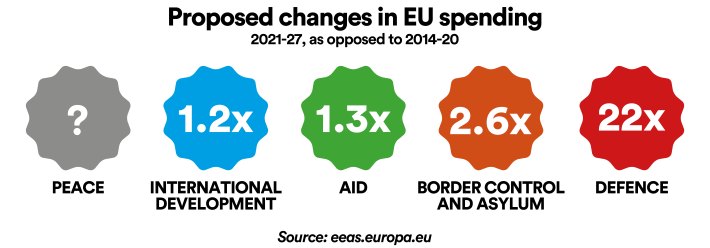
Human rights and development funding fares better in the proposed new
budget, rising by approximately 25% compared to the period 2014-2020.
But when compared to
the plans
for a European Border and Coast Guard Agency, a European Union Agency
for Asylum and their associated funds, the priority is clearly building
walls rather than building bridges. The EU calls it “addressing the root
causes of migration,” but among NGOs like QCEA it feels like the
ghost of Fortress Europe is simply back to haunt us. Maybe he never went away?
*
It’s easy to read this and despair – wasn’t the EU meant to be about
making the world a better place; a spirit of brotherhood? Well, yes. But
it’s important to remember two things. Firstly, when the EU was
negotiating its last budget and accepting its Peace Prize in Oslo, the
world was a different place. Back then, its biggest concern was fiscal
stability in the wake of the Eurozone crisis. Brussels has now become
the forum for a totally different set of challenges. Which brings us to
the second point: we’re all guilty of ascribing too much agency to the
EU. We talk about its policies and decisions, its successes and
failures, but if anything it’s a mirror for the collective concerns and
interests of its members. And many of its members are currently in the
grip of xenophobia, populism and nationalism. If the EU is to right its
course and embody its founding values once again, national politics –
and voters across Europe – must wish it to be so.
The EU is a major player in global affairs, shaping the world we live
in by virtue of its size alone. But it is nonetheless a blank canvas,
pulled taut in different political directions, on which a myriad of
actors seek to chart Europe’s future course. It is up to us all to
provide the compass; in Brussels, QCEA aims to show the way.
